
The Content Loop:
Forcing Innovation, Repetition, and Doing Dope Shit

The Creator’s Dilemma
Every day, your favorite content creator—whether they’re a blogger, YouTuber, or podcaster—has to post something new.
Ryan Holiday has to find another way to package Stoicism for modern life. Your go-to “science-based” fitness influencer needs to convince you that today’s “S-tier” exercise is the key to optimal hypertrophy. Chris Williamson has to come up with a new heuristic to impart to you on another episode of Modern Wisdom. Even I have to develop a fresh way to pontificate about exercise and coaching, like some kind of poet trapped in the world of a strength coach.
The demand for new content is relentless, both for creators and consumers. This constant churn pushes creators to grasp at straws, stretching ideas just to feed the algorithm. See the backlash against “evidence-based lifting” and the strawman arguments built around one or two studies. But this churn also forces innovation—new methods, new perspectives, and new ways of saying the same thing.
Repetition: Feature or a Bug?
There are only so many ways to say that the basics, done consistently, are what actually work.
Personal finance? Earn well, spend less than you make, and invest in index funds
Building muscle? Lift, eat enough protein, sleep
Relationships? Find someone you’re a fan of who’s also a fan of you
Call it the 80/20 principle, where 20% of our inputs create 80% of our results. Call it Occam's Razor, where the simplest solution is often correct. Call it the big rocks story, where you fill your life with what matters before worrying about the sand. Or maybe even a personal favourite, the midwit bell curve meme; at both extremes, the answer is simple, while those stuck in the middle overcomplicate everything.
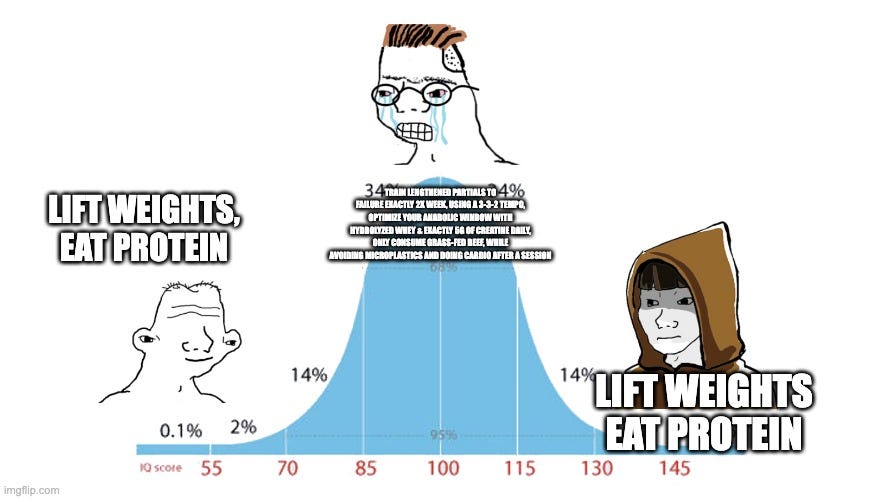
The basics seem too obvious at first, so on the surface, we keep searching, hoping for a more sophisticated answer.
In the same way, the above ideas could be summed up as "Keep It Simple, Stupid." It just might take us a while to figure that out.
And that’s why repetition isn’t a flaw—it’s a feature. We hear the same principles over and over, packaged in different ways, until one finally clicks with us. Like some kind of unteachable lesson, understood only through experience.
Old ideas are just as valuable as when you first heard them. But they may not resonate the first time, so you must hear them again. Conversely, maybe it’s the new idea that sets you in motion and allows you to see what was right in front of you all along with fresh eyes.
However, in the pursuit of novelty, these insights get buried. The cycle repeats. We’re not just looking for the best way. We’re avoiding the reality that we already know what to do—we’re just not doing it.
The Dopamine Loop of Avoidance, Not Discovery
This endless search for new insights traps us in a dopamine-fueled discovery loop, always hunting for the next idea that will reshape our worldview. We tell ourselves it’s because we crave novelty or want to find the best way. But what we really want is the safety of pursuit instead of the risk of action.
This is why we get trapped in the loop—we chase insight but not action. In German, there’s a word for this: Erfolgsangst—success anxiety. Not just the fear of being wrong, but also the fear of success. Because success brings responsibility. If you take action and fail, you lose the excuse of not knowing enough. And if you succeed? Now you have to live up to it.
So we stay in preparation mode. We keep consuming instead of acting. We never send the cold dm, quit the job, create the program, or start the business. Because if we never try, we never fail. And if we never fail, we never have to confront what we’re truly afraid of: seeing what we’re actually capable of.
The Silver Lining
This pressure forces creators to stretch their thinking, to refine and expand their ideas, and to innovate at a pace faster than ever before. Even this very observation—the awareness of the cycle—is a product of it.
But for the consumer, what’s the real benefit? If you’re constantly searching for the next insight, when do you take action on these lessons you’re perpetually learning? You’re not even consciously getting on the ride through the loop, let alone knowing when to get off.
This is why, paradoxically, the repetition has value. The ideas that truly matter—the ones that resonate with you—will keep resurfacing. The “new” ideas might be the very ones that work for you.
So, no matter when you join the party, you’re precisely on time (like an internet age Gandalf). Maybe that’s why it works. Maybe you need to hear the same idea over and over until it lands in the right way at the right time. Maybe you needed to hear this exact thing, right now, in this exact way. Or maybe this will be a memory of the first time you heard this, when this message is repeated to you years from now.
The repetition isn’t a flaw—it’s a feature.
“Everything that needs to be said has already been said, but since no one was listening, everything must be said again” - André Gide
Because in the end, we need to be reminded more than we need to be taught.
So consider this your reminder for the day.
Stop waiting. Do the thing.
Do dope shit.